


Custom 3D Printing: Turn Your Idea into a Real Object
From Idea to Model: When 3D Printing Becomes Truly Custom
One of the most interesting aspects of 3D printing is the ability to create fully customized objects. Unlike traditional manufacturing, where you often need to adapt to existing products, 3D printing allows you to start directly from an idea and turn it into something tangible.
Custom 3D printing is based on a simple principle: there is no one-size-fits-all solution. Every project is tailored to specific requirements. Whether it’s a technical component, a decorative object, a prototype, or a functional part for professional use, each piece is designed around its intended application.
Many people approach 3D printing with a simple idea—sometimes just a sketch or a reference image. Others start from a complete 3D file. In both cases, the process is similar: the project is analyzed, the most suitable material is selected, and dimensions and technical features are defined before production.
This flexibility is one of the reasons why 3D printing is increasingly used by both individuals and businesses. It allows the production of unique parts or small batches without the need for molds or expensive tooling.
When the process is properly managed, 3D printing becomes an extremely powerful tool for turning an idea into a real object.
Unique Objects, Prototypes, and Custom Components
Custom 3D printing can be used for a wide range of projects. Some requests focus on creative or decorative objects, while others are driven by precise technical requirements.
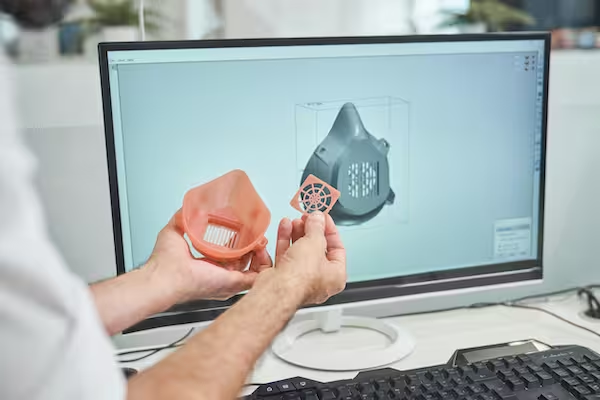
A common example is prototyping. Before moving to large-scale production, many companies prefer to test a physical version of a project to verify dimensions, functionality, and assembly. 3D printing makes it possible to quickly produce a model that can be evaluated and refined.
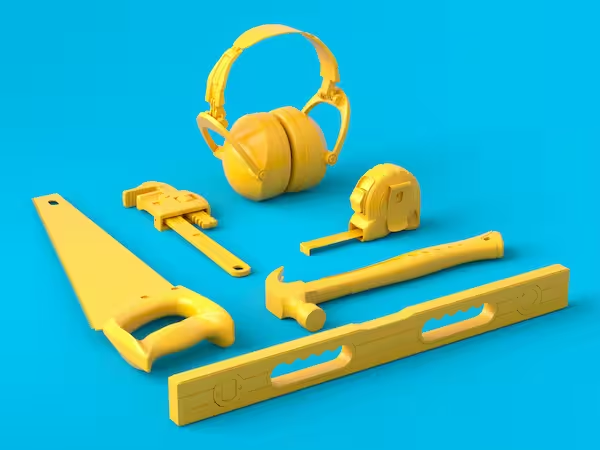
Another frequent application involves custom components. In some cases, it is necessary to create a support, an adapter, or a replacement part that is not available on the market. In these situations, 3D printing offers a practical solution, allowing parts to be designed and manufactured with exact dimensions.
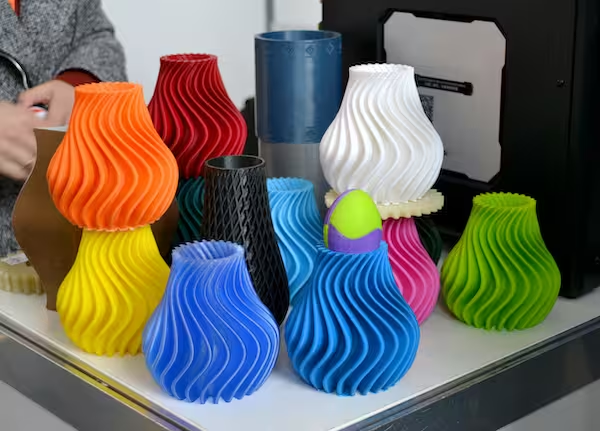
Customization also applies to simpler but unique objects, such as personalized nameplates, decorative elements, gadgets, accessories, or parts for creative projects. Even in these cases, 3D printing makes it possible to create something that would be difficult to find ready-made.
One of the main advantages is design freedom. There is no fixed product catalog: each project can be adapted, modified, and improved according to specific needs.
FDM Technology and Custom Production
In our lab, we use FDM filament-based 3D printing, a technology particularly well suited for producing custom objects, functional prototypes, and technical components.
This method uses thermoplastic filaments that are heated and deposited layer by layer until the final object is created. The result is a solid, functional component that can be produced in different sizes and with a wide range of materials.
FDM technology is highly valued for its versatility. It allows the production of unique parts without the need for molds or specialized tooling, making it ideal even for very small production runs.
Another key advantage is the ability to easily modify a project. If changes are needed during development—such as adjusting dimensions or improving a specific feature—it is possible to quickly update the file and produce a new version.
This approach is particularly effective for custom projects. Each object can be adapted to real requirements, without the limitations typical of standardized production.
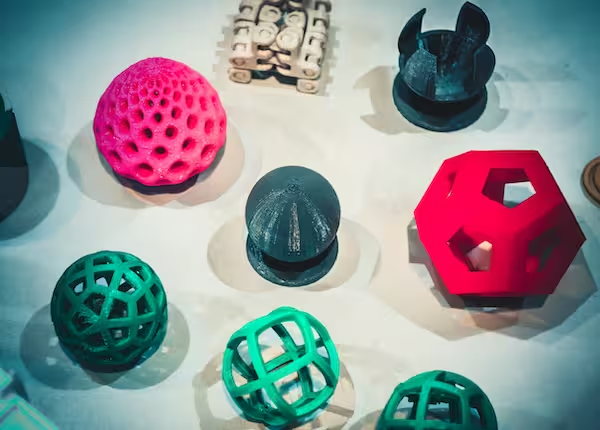
When Custom 3D Printing Makes the Difference
There are situations where standard products are not enough. This happens when a component is not available on the market, when an object must fit specific dimensions, or when a truly unique solution is required.
In these cases, custom 3D printing becomes an extremely effective solution. Instead of adapting existing products, it allows you to design and produce a part that perfectly meets the project requirements.
This approach is widely used, for example, in the production of technical supports, adapters, custom fittings, and specialized components.
The ability to produce a single part or a small batch without high industrial costs makes 3D printing an accessible solution even for highly specific projects. In many cases, this flexibility enables the creation of objects that would be difficult to achieve with traditional manufacturing methods.
A Flexible Process Designed for Custom Projects
Each custom 3D printing project follows a slightly different path, as every object has its own characteristics and specific goals. Some projects start from ready-made 3D files, while others begin with an idea to be developed or an existing object to be modified.
The first step is always to understand the function of the part: does it need to be strong? Does it need to fit with other components? Is it purely aesthetic? These questions help define the most suitable material and technical characteristics.
Once these aspects are defined, the model is prepared for printing and produced using FDM technology. The process builds the object progressively, layer by layer, until the final result is achieved.
This method also allows quick modifications. If changes are needed during development—such as adjusting dimensions or improving a feature—the model can be updated and a new version produced without restarting the entire process.
It is precisely this flexibility that makes custom 3D printing such an effective tool for turning ideas and projects into real, functional objects.