


3D Printing: What to Know Before Making a Part (Without Mistakes)
3D printing is not simply about “pressing a button and waiting.”
It is a technical process that, when managed correctly, allows you to obtain functional, precise, and durable parts.
If handled improperly, it can lead to deformations, poor fitment, and incorrect material choices.
You won’t find the classic generic definition here.
You’ll find what really matters when you need to transform a file or an idea into a real object.
Not All 3D Printing Is the Same
Many people talk about 3D printing as if it were a single technology. In reality, there are different approaches, materials, and very different results. An aesthetic prototype does not have the same requirements as a mechanical component. A large part cannot be handled the same way as a high-detail miniature. The real difference is not the machine. It lies in the experience: file preparation, part orientation, and understanding how the material behaves during cooling.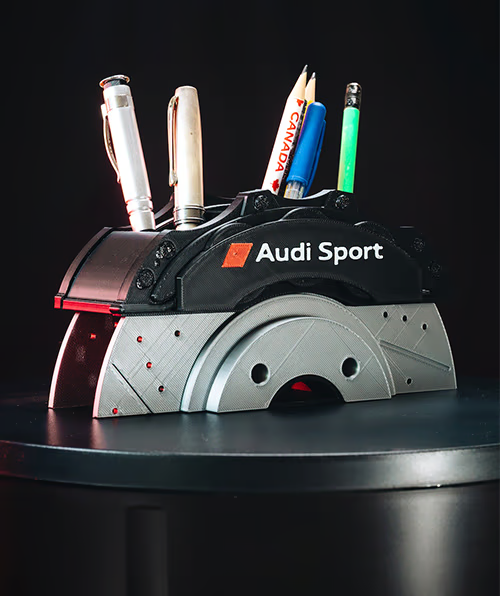
What Actually Happens During 3D Printing
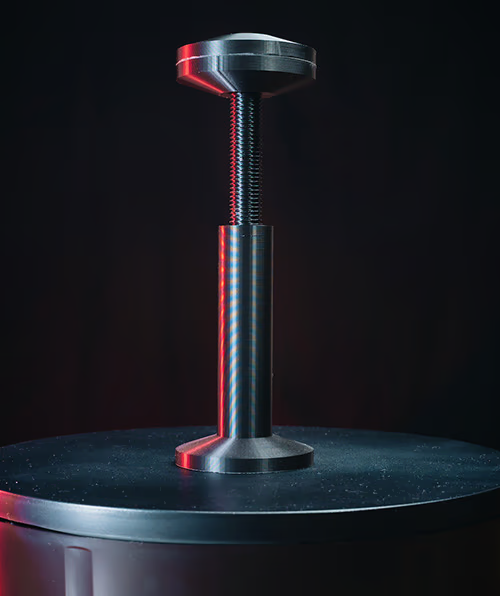
Every object is built layer by layer. This means strength is not the same in every direction. If a part needs to withstand loads or torsion, its orientation in the machine becomes a technical choice, not an aesthetic one. In addition, every material behaves differently: some shrink slightly, others are more flexible, and some react to humidity. Ignoring these aspects means risking an inaccurate result. 3D printing works best when the design is developed with the printing process in mind from the start.When 3D Printing Really Makes Sense
- When you need a unique part or a small batch
- When a replacement part is no longer available
- When you need to test an idea before industrial production
- When customization is essential
It is not the ideal solution for large-scale industrial production with already optimized molds,
but it is extremely effective during development, modification, or adaptation phases.
Materials: choosing the wrong one is the most common mistake
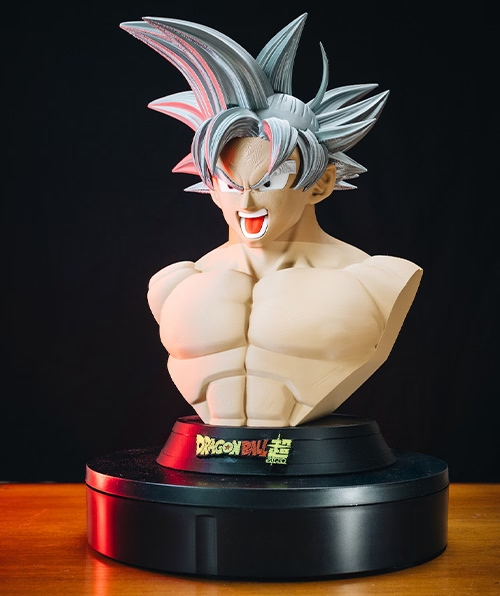
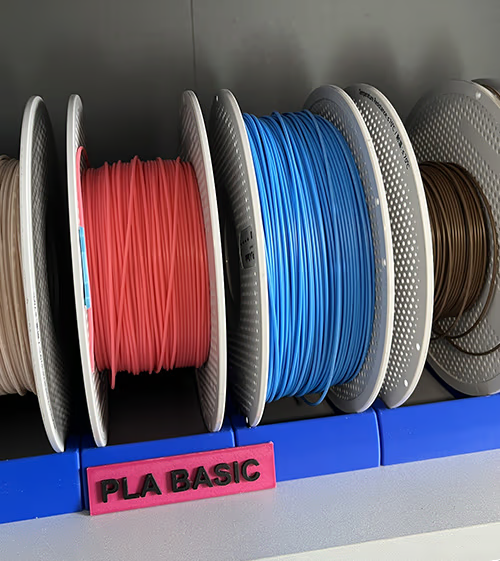
One of the most frequent mistakes is selecting the material based only on price. A part that needs to operate near heat sources cannot be printed with a standard material. A component subject to impacts must have appropriate mechanical properties. La scelta del materiale dovrebbe sempre partire dalla funzione del pezzo, non dall’estetica.Tolerances and Fits: the Detail That Makes the Difference
3D printing is not CNC machining.
Fits must be designed with proper clearances in mind.
Even a fraction of a millimeter can make the difference between a smooth assembly and an unusable part.
For this reason, when producing components that need to fit together, a technical verification before final production is always recommended.
How Much Does 3D Printing Cost?
The cost does not depend only on size.
It is influenced by:
- Machine time
- Material
- Geometric complexity
- Supporti necessari
- Post-Processing and Finishing
A serious quote is not based only on the weight of the part, but on the entire production process.
Why Choose a Professional Service
A 3D printer is just a tool.
But achieving a consistent, functional, and repeatable result requires experience.
A structured service analyzes the file, evaluates the final use of the part, and proposes the most suitable solution.
This avoids errors, reprints, and material waste.
Frequently Asked Questions
Is it strong?
Yes, if it is properly designed and made with the right material.
How long does it take?
It depends on size and complexity.
Small parts can be ready quickly.
Can you print a part that is no longer available on the market?
In most cases, yes — after dimensional verification or 3D modeling.