



3D Printing Materials: Properties, Strength, and Applications
The choice of material in 3D printing directly affects the strength, accuracy, and durability of the final part. Each material has specific properties that make it suitable for different applications.
Material selection is one of the most important aspects in additive manufacturing.
The chosen material directly impacts mechanical strength, dimensional accuracy, and the final use of the component.
Each material offers different characteristics: some are more rigid, others more flexible, while some are designed to withstand high temperatures or mechanical stress. For this reason, material selection should never be random, but always based on the intended application of the part.
When the right material is selected, 3D printing can produce functional parts, technical prototypes, and ready-to-use components.
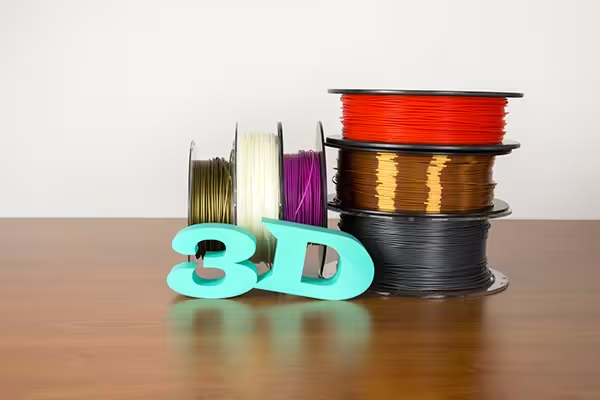
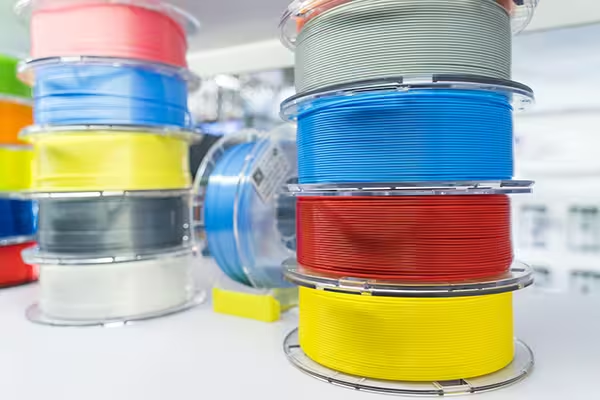
Why material selection is so important in 3D printing
Many people assume that 3D printing mainly depends on the machine used. In reality, the material plays an equally critical role in determining the final result.
A component intended for aesthetic use can be made with standard materials, while a part designed to withstand loads or stress requires more resistant materials.
Key factors that influence material selection include:
- required mechanical strength
- operating temperature
- exposure to humidity or chemicals
- required precision
- long-term durability
Evaluating these factors before production allows for more reliable components.
PLA: the most widely used material in 3D printing
PLA PLA is one of the most commonly used materials in 3D printing, especially for prototypes and parts that are not subject to high mechanical loads.This material is appreciated for its ease of printing and good surface quality, allowing for clean and detailed results.
Key characteristics include:
-
good rigidity
-
easy post-processing
-
good aesthetic finish
-
wide availability of colors and variants
PLA is often used for prototypes, display models, decorative objects, and components that are not subject to high mechanical stress.
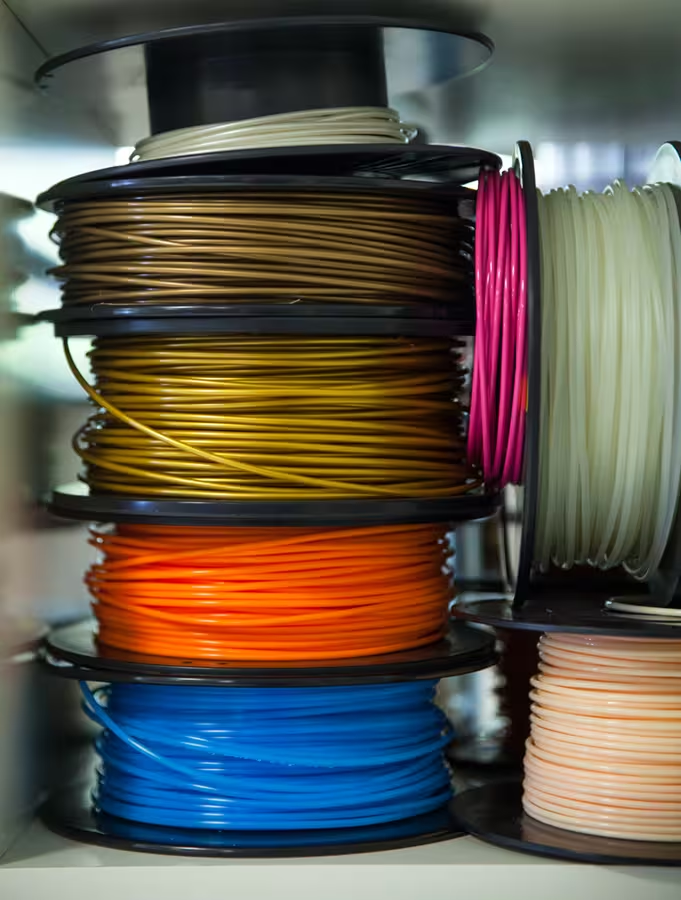
PETG: strength and versatility
PETG is widely used when higher strength is required compared to PLA.
This material offers a good balance between rigidity and impact resistance, making it suitable for many technical applications.
Key characteristics include:
Good mechanical strength
higher impact resistance compared to PLA
good moisture resistance
decent dimensional stability
PETG is often used for functional components, technical supports, and parts intended for more demanding applications.
ABS: strength and thermal stability
ABS is a material widely used in industry and is also employed in 3D printing for components that require higher thermal resistance.
Key characteristics include:
good resistance to high temperatures
good impact resistance
possibility of post-processing
ABS is often used for technical prototypes and components intended for more demanding environments compared to standard materials.
Technical materials for advanced applications
In addition to the most common materials, there are several technical materials for 3D printing designed for specific applications.
Questi materiali possono offrire:
Higher mechanical strength
high temperature resistance
longer lifespan
improved performance in industrial environments
In professional or industrial contexts, material selection therefore becomes a fundamental phase of the process.
How to choose the right material for 3D printing
Material selection always depends on the final application of the component.
Some useful questions to consider:
- Does the part need to withstand loads or stress?
- Will it be used in high-temperature environments?
- Does it need to be impact-resistant?
- Is it mainly for aesthetic purposes?
Answering these questions helps identify the most suitable material for the project.
Materials and print quality
Another important aspect is the relationship between material and print quality. Some materials allow for smoother and more detailed surfaces, while others prioritize mechanical strength.
For this reason, it is often necessary to find a balance between:
aesthetics
strength
precision
production costs
A preliminary project analysis makes it possible to choose the most suitable solution.
The importance of technical support
When it comes to technical projects or functional components, choosing the right material can make the difference between a part that works and one that needs to be reprinted.
For this reason, before starting production, it is always important to carefully evaluate both the material properties and the project requirements.